Showing posts with label writing. Show all posts

Wednesday, February 3, 2016

Apologies, alternate blog, a little writing!

I apologize for being so quiet on this blog for so long. Life has been busy. Also, I started a new blog where I feel a little more free about the topics I post on. You can visit my other blog here.

I have not written much/any poetry for quite a while, though I did participate in NaNoWriMo this past November, completing my goal of over 50k words in 30 days. Here is my NaNo novel page, and a short excerpt:


Wednesday afternoon at 4:45 p.m., Lieutenant Ann Hunt was “snooping” around Helton University’s campus. Of course she didn’t think of it as snooping, as it was her job to investigate criminal activity. But since Dino Youngblood was only a “person of interest” in the N.O.R.L.E. laboratory break-in case, and she was not officially investigating that case, this probably fell into the gray area between professional investigating and “snooping.”
The detective came to the campus wearing civilian clothes, and parked an unmarked car in the guest lot closest to Candelaria College. [sp?] She had photographs of Youngblood, and knew his license number – for a motorcycle. Not seeing the cycle parked, she decided to start at the building where he had his office.
According to the University’s class schedule, Youngblood was to be teaching a 300-level class on astrophysics in a small lecture hall on the ground floor in the same building. Ann walked around to the closest entrance, and found the building directory. The lecture room was close by. A student passed her in the hall, and Ann pretended to be looking at her phone.
Approaching the lecture room, the detective could hear a discussion through the halfway open double door. A handsome brown-haired man wearing a white lab coat stood in the aisle and was having a a lively conversation with some of the students. Hunt recognized Dino Youngblood from his profile photo. Could this be someone who would break into a lab in another university? If it was, why would someone suspect him unless there was definitive evidence, she thought to herself.
She decided to visit Youngblood’s office while he was occupied. She stepped back quietly, and found the nearest stairs. The office would be on the second floor, near the other end of the building. It was a fairly long, narrow building dating probably to the 1970s, with no obvious updates aside from some of the windows.
Ann passed through a corridor designated as the astronomy department, and found several of the offices were occupied at this time of the day. This could complicate, or perhaps assist her “snooping.”
Coming to a bend in the hallway, Hunt paused and checked for other faculty or students in the area. Youngblood’s office door was near the end of a small ell in the building, where it adjoined an older building designated as the chemistry department. The overhead lights were not on in this section, and the door was partly in shadow. However, Hunt could the more clearly see a light under the door. Either someone was inside, or Youngblood left his light on. She decided to knock.
Approaching the door, she saw a small board with announcements tacked up – upcoming lectures, Youngblood’s office hours, and a journal rack with a recent copy of an astrophysics periodical. Hunt listened, but could not hear anyone moving or speaking inside the office. She knocked twice.
No answer. She thought the light under the door wavered momentarily. That seemed like someone inside, possibly aware of her but trying to be unnoticed.
“Hello?” said Ann. “Doctor Youngblood?”
She silently cursed herself. If someone challenged her, she would not be able to explain how she did not see that Youngblood was currently in a lecture without looking foolish.
Ann detected no sound or further sign of movement inside the office. She checked the doorknob. It turned with a slight click. The door was not locked.
Slowly pulling the door open, she found the room small and cramped with shelves, filing cabinets, two desks, and stacks of journals and textbooks. There was no living thing, but a wall calendar and a few posters depicting plants and animals from tropical places. Puerto Rico, and, she guessed, Hawaii.

Thursday, January 15, 2015

Process (a #TBT)

Process (a #TBT)

It is always recommended for artists of all stripes to carry some kind of notepad or sketch pad with them at all times, for jotting down ideas on the go.

This is a page from my notepad/scheduler from April, 2010. You can see my classes for that day, that it was a sunny day, a reminder to bring life savers to my voice lesson the next day, and that I planned to watch Casablanca off Netflix that evening. (Old-school DVD style!) I also wrote down a few stanzas of poetry as the lines came to me, because I was sitting on the bus thinking about what a nice day it was. Later that day I edited the four stanzas into a poem, and a while later set them to music as a song.


So you never know when, in between grocery trips and bus rides on a sunny day, you might have an idea that can go somewhere with a little more work.

April 12, 2010 - Sunny day!

Thursday, August 15, 2013

Reflections (non-music)

It is hard for me to have a blog about just my music, or just my poetry. I've been reading about writing lately, and feel like I wish I did more of it. So here is what I've been thinking about this morning. I don't know why, exactly. Maybe I am just feeling the passing of time as the summer starts to roll up into overcast late August days like today.


Reflection on loss – family, mortality

The Compassionate Friends is clearly a great organization, and I'm pleased to help the Salem chapter out with their website and emails, but I've never attended a support meeting. I've never lost a child or brother or sister or niece. Both of my parents are still living and doing fine, as are my sister and brother. I can't really imagine the experience of losing someone in my immediate family, though I do remember somewhat how it felt to come home one day in the first grade and find out my mother had been in a terrible car accident and nearly died. And I do remember having bad dark dreams as a young child in which my mother was deathly ill and I felt abandoned, alone. It was a cold, almost paralyzing feeling.

When a personal love relationship of ten years ended for me in 2008, I felt destroyed, and at times thought it would have been better if the person I loved had died, because then it would not somehow be my fault. It would not feel like a choice outside my control, made by someone else I cared for, to not be part of my life any longer. Of course this was just a thought I had. I don't know if it's true beyond the feeling of loss I was experiencing at the time.

In 2009, my father had a near-fatal heart attack, and at first it seemed likely my family would have to go on living without him. But then he miraculously recovered, and we did our best to put that thought aside.

All of my biological grandparents are no longer living. The last one passed on in 1997. That was a great loss, but not the same as it would be to lose someone I grew up with, seeing nearly every day, a part of my basic family unit. I wished I could have known my grandparents better. But I was too young.

Some day I will lose someone close. It will probably be sudden and unexpected. Perhaps I will see them for the last time in a hospital, and be allowed to say goodbye. And someday I will pass on.

People sometimes talk about living each day as if it were our last, but can we really live that way? Wouldn't that be a terribly morbid attitude to hold? Somehow, I feel maybe it is healthier to live each day as if there will be many more to come, because any one day is all we ever have, but no one day is so important that it could be more than just a day in a lifetime. At the same time, we should never take the people we have in our lives for granted. Each time we say goodbye might be the last time.

Sunday, December 30, 2012

Contentment (2001)


Contentment

Contentment curls up on the rug by the fire.
Wind doesn't chill,
Rain doesn't soak, and
Worries don't dance with the shadows on the wall.

The unread book lies open on page one;
Leaves are uncreased,
Buds are un-pressed, and
The words of tomorrow are waiting to be told.


(4/19/2001)


I wish all cold winter evenings could fit the positive and optimistic image of this poem. This is an older one of mine as you can tell by the date. I started writing the dates on my poems at some point because, even if they are not published, I am curious about the sequence and the time of year. What was going on in my life when I wrote this? So the date is mainly for my own sense of personal history.

Not too long ago I submitted a small set of haiku to a local literary art journal but it was not accepted. I felt disappointed and a little surprised, but then felt amused when I saw the publication in print. I decided my work didn't really fit with what they'd printed. I suppose the meaning for me in this kind of experience – putting myself and my work out there for others to see and judge – is that I write poetry, music, etc. as I like it to be. I write to please my own sense of artistry. I then put my work out there because I don't want to be selfish and alone, because I genuinely want to share what I create with others, and because you just have to do work out in the public view to be an artist. But if someone doesn't like what I write, or it doesn't fit what someone is looking for, that should not be a problem. I will just keep on writing because it works for me. Even if someone were paying me to write or create something for them, I would still want that work to come from my voice and reflect my sense of what is good. I know when I've done a good job, and it's not when someone else says. This can create a sense of conflict, and I tend to feel timid and cautious about putting myself out in the world, but I know the real reason I create is not to please others but because creating pleases me and I need to be doing it.

In hindsight about this one case, I feel like maybe I could have "sold" my work better, too. But I'm still fine with it not making the "cut" because I know it wasn't because the work I'd done was not worthwhile.

Sunday, May 22, 2011

Sunday, February 20, 2011

Memory and Forgetting

Memory and Forgetting

Maybe I am forever changed, or
maybe I try too hard
to "let go" and "move on"
when it all comes down to just doing
what I want --

Issa apparently wrote:

Mother, I weep
for you as I watch the sea
each time I watch the sea.

Do we ever forget those who move our lives so?

All the things I did and wrote years ago
don't seem to help me with today's
unwritten lines.
I ask myself why did I do and write those things then, and
how did I get through the terrible feeling
I could die before I finished each one,
or was it even the same feeling?
Each task I set out again to do,
just to write a few pages,
each starting point with an almost-forgetting
my prior death-struggle, all
so dramatic.

Today I told myself,
I give my permission
not to take up this new struggle
if that is what I want. If that is
how it turns out, in the end,
I will let that be OK.
Let me remember myself
and forget the pain.

It concerns me, still.
It is so hard to trust and hope.
But I am calmer when I
remember myself
and forget the pain
for a little while at least.


(2/20/2011)

Saturday, May 29, 2010

Knowhow

Knowhow

If birds and
butterflies don't know
the mysteries of life,
how can the poet?
Steel bars know
strength to knit
engineers' bridges wide;
the pen knows its
ink like the clover
knows its green.
The tree knows, too,
the soil undertrod
and how it is
to reach and grow,
and fall, while
stars all know
their own ways
through vastness.
All do.
How is it to be?


(5/29/10)

Saturday, January 16, 2010

Strangers No More

Strangers No More

Your daughter and
My daughter, they were
Strangers to one another.
They knew nothing
About the other, but
Now they find themselves friends.

This neighbor and
Another neighbor, they had
Doors locked on each other,
Always tried to
Ignore one another;
Now they let themselves in.


(1/16/2010)


Most poem ideas come to me late in the day, sometimes keeping me awake at night, insistent I must write them down before they will let me sleep. This one woke me up this morning. Any day I write a poem is automatically a good day.

Words

Words

Words spread across the surface of things
To fill up the curved hollows of thought.
Naming all impossibilities,
We raise an island of sand among the dreaming currents.

Communication, a response,
I feel it all through the text of my skin:
Meaning before death is my only way.
And what if someone understands me?


(11/15/2009 & 1/16/2010)

Thursday, August 6, 2009

In Defense of Descartes' Malin Genie Hypothesis (1996)

In Defense of Descartes' Malin Genie[1] Hypothesis
by Chris Kaltwasser
(OSU Philosophy Department Matchette Award Winner, 1996)

Suppose one day you walk into a room and see flowers in a pot on the table. Are those flowers real? How can you tell? Suppose you take a closer look. You reach your hand out and pick up the pot. You feel the weight of it press down on your palm. As you bring the flowers closer you can smell their pleasant fragrance. Reaching out your other hand, you touch the petals. They feel soft and delicate. Setting the pot by the open window, you observe as a lazy bee alights on one and then another of the blossoms, busy collecting pollen. Do you know these are real flowers now? Might they not be a clever illusion, designed to fool you into thinking you are seeing, holding, smelling, and touching flowers? René Descartes proposed just such a problem in his Meditations on First Philosophy: We know our senses can be mistaken—perhaps this is always the case. O. K. Bouwsma, many years later, suggested this hypothesis was itself a case of trickery. He argued that flowers you can see, hold, smell, touch, and so forth could not be an illusion, but instead that reality is what we should call them. However, Bouwsma is the one who is playing tricks with the words "illusion" and "reality."

In his Meditations on First Philosophy, Descartes takes as his project to discover and defend a trustworthy basis for knowledge. For him, reality is the substance of existence and not mere perceptions or appearances to the senses. Two contradictory claims about reality cannot both be true. To have true knowledge means to have ideas which correspond accurately to reality. Knowing he has often been mistaken in his former beliefs, Descartes determines that he will systematically demolish his "house of knowledge," to find a solid foundation on which his knowledge can be built reliably. Believing that his mind will habitually fall into its old ways of error, Descartes determines that he will withhold assent from any of his former beliefs, as he employs a number of skeptical hypotheses to strip away all which is not manifestly true. He realizes that nothing which he formerly had believed is beyond reasonable doubt, because he finds that he has valid and well-considered grounds for doubt (Descartes, 4). By employing his method of doubt, he intends to discover some unshakable foundation for knowledge, something which he can know to be true without possibility of doubt.

Each of Descartes' skeptical hypotheses takes the form of a supposition that reality is in some way not as he has formerly believed, but instead some other reality accounts for his beliefs and perceptions. By a wave of three such hypotheses Descartes soon reduces his grasp of truth to mere elementary notions of extension, size, quantity, and number of things. He can doubt his beliefs of the external world, by supposing that all he senses of the world around him is pure fantasy, the product of his own dreaming mind independent of any reality, much as a painting might depict objects and creatures which never existed nor could exist in reality (Cottingham, 40-41). Then, as his ultimate hypothesis, by which he calls into doubt even these last elements of belief, Descartes supposes that his mind is deceived every time he contemplates even the simplest of ideas. When he adds two numbers, some mischievous agent insures that he produces the wrong sum without realizing his error. Not merely may he err, as he knows he sometimes does, but he is consistently deceived by the design of a malicious power:

I will suppose, then, not that there is a supremely good God who is the source of all truth, but that there is an evil demon, supremely powerful and cunning, who works as hard as he can to deceive me. I will say that sky, air, earth, color, shape, sound, and other external things are just dreamed illusions which the demon uses to ensnare my judgment. I will regard myself as not having hands, eyes, flesh, blood and senses—but as having the false belief that I have all these things (Descartes, 4-5).

Then, with a note of final triumph, Descartes handily smites his malin genie and establishes one truth which he asserts even this strongest of hypotheses cannot call into doubt: Descartes himself must exist, if he is deceived. As much deceptive power as he grants to this demon, Descartes cannot think himself to be nothing while he thinks that he is something (Descartes, 7). Armed with the unshakable knowledge that he exists as a thinking thing, Descartes proceeds with the rest of his Meditations to construct what he believes to be a framework for reliable knowledge.

We shall now briefly consider Descartes' theory of perception, of which the two central components are his concepts of causality and of ideas. Of the former, he holds that there must be as much reality in a cause as in an effect, and that the causal relation between things is a transfer of some formal or eminent reality from the cause to its effect. Hence, "it follows both that something cannot come from nothing and that what is more perfect—that is, has more reality in it—cannot come from what is less perfect or has less reality" (Descartes, 18). Of ideas, Descartes holds that ideas are modifications of thinking, which is the essential quality of his existence from which he cannot conceive himself to be separated. The view of perception that Descartes takes, then, is that there must be some archetypal reality which is the cause of all ideas. All ideas are like images of that formal reality from which they derive, and perceptions are representations of real things either from the mind itself or from things outside of the mind (Descartes, 19).

The validity of Descartes' arguments for a foundation of knowledge depends very significantly on the coherency of his skeptical hypotheses. By them he has toppled both his senses and his imagination as reliable means for attaining knowledge of reality, and builds instead on nothing but reasoning from his own existence and thought. If the illusions of the evil demon do not call all but his existence as a thinking thing into doubt, as Descartes claims, then his arguments are effectively crippled. If his supposition about the evil demon does violence to reason in some way, the consequence is that he has doubted what cannot reasonably be doubted and laid the foundations for knowledge far "below" where they ought to lie.

In his essay, "Descartes' Evil Genius," O. K. Bouwsma argues that Descartes' last hypothesis has in fact done violence to the concepts of illusion and reality. He submits the hypothesis to a trial by proposing two adventures for Descartes' evil demon. By the first of these exercises, Bouwsma proposes to show an ordinary illusion. It is one which can even be detected by the careful attention of one of the demon's victims. In his second exercise, Bouwsma proposes to reproduce exactly the scenario Descartes describes at the end of his first Meditation, and this, Bouwsma argues, is no illusion at all.

For the first adventure, Bouwsma supposes the evil demon is in the mood to exercise only some of his unlimited powers to deceive. He will construct a malicious deception, changing everything in the world to paper. Flowers, trees, sky, sun, and even human beings will be nothing but paper, carefully crafted to fool the unwary eye. This is the illusion Bouwsma proposes: that everything will appear very like normal, but in fact everything (except paper itself) will be changed. Bouwsma then supposes there is a young man named Tom who sees through the illusion. The flowers on the table are really paper. The young woman, Milly, is paper. The window, trees, houses, sky, sun, clouds, rain, and Tom himself are all paper. Tom experiences the illusion, but is not deceived because he knows the difference between paper and these other things, despite the fact that the paper illusions are carefully designed to fool him. An illusion, according to Bouwsma, is something that seems like something it is not. The given illusion is that the world is as we take it to be: flowers, trees, people, and paper, all distinct and real. The reality is that there is nothing but paper (Bouwsma, 30).

Ever cunning and malicious, the evil demon is not satisfied with his first attempt at deception. In what will be his second adventure, Bouwsma supposes that the evil demon now undertakes the project of constructing a world of illusions by which poor Tom will be thoroughly deceived. When Tom thinks he senses a thing, he will in fact be deceived, because there will be no such thing. To this end, first the demon must do away with all that is real in the world except for Tom himself, to which he restores his former life. Now the demon arranges things so that Tom believes everything is as it was before, that what seems to him solid and real is as it was before, just as solid and real. All this Tom believes, but all in fact are the products of the demon's deception.

Bouwsma now examines the illusion world created by the demon, and concludes that it is in fact reality, not illusion, which the demon has reproduced. The demon desires recognition for his cunning deception, and so decides to enter into Tom's perceptions and plant the seeds of doubt. Instead, Tom shows the demon that he has failed to deceive. The demon enters into Tom's experience, sharing with him the senses of seeing, hearing, tasting, smelling, and feeling. Nothing is missing. The flowers are still as pretty to see, as delicate to touch, as sweet to smell. Tom can gather their pollen, send them to Milly, or do anything else one could normally do with flowers. It seems that the demon has not done away with flowers or Milly or Tom's body, but only with what it was the demon could sense of these things beyond human sight, hearing, touch, smell, or taste. Tom is not taken in by the demon's deceptions. To Tom, everything is as it was before. The flowers are still flowers, the sky is still sky, and Milly is still Milly.

How is this so? According to Bouwsma, Tom is a clever lad. The demon may say that the flowers are not real, that he has in fact destroyed all flowers, but there they are in front of Tom, as real as they ever were. They are real and not illusions, Bouwsma claims, because they do not differ from real flowers as far as Tom is concerned. Sight, smell, and touch all verify the existence of these flowers, so for Tom, what the demon is insisting are mere illusion are in fact what a human being would call reality without a second thought. The demon may be able to reach out with some extra sense and miss the presence of the flowers, but no human being could do this. So, the demon has in effect constructed his own illusion. The flowers and Milly and everything else are still present and real to Tom. It is only the demon who has removed what it was he sensed of the flowers and Milly and the rest beyond the senses available to a human being, and is left with a world of illusions.

But there seems to be a trap in Bouwsma's argument. What about Milly? Poor Milly has no life. She has no awareness and no senses. She has no existence. We have granted this demon unlimited power to do and to deceive, and he has done this terrible deed: he has killed Milly and replaced her with an illusion. The demon, even in his perverse desire for recognition, never thinks to tell Tom this fact, but only uses the flowers as an illustration of the deception. There is no Milly, just as there are no flowers. If Tom speaks to Milly, or touches her hair, or kisses her, she will not subjectively hear or feel or give that kiss in return. Tom is alive, but Milly is dead. Tom can sense everything he could before, including the flowers and Milly, but he is deceived if he thinks they exist in reality. All that exists in the world is Tom, Tom's perceptions, and the evil demon, and though the demon has insured that Tom's perceptions lack nothing they formerly contained, they clearly are illusions.

An illusion is something falsely believed to exist, or, it is a false belief about reality. Reality is what exists in the world. When Bouwsma argues that the paper world of the evil demon's first adventure is an illusion, he is correct. The paper flowers and people and sky are imitations designed to fool. Those who mistake the paper imitations for the things themselves are taken in by the illusion. When Tom discovers the truth, that there is nothing but paper in place of these things, there is no more illusion for him. When Bouwsma argues that the dream world of the second adventure is reality, he is mistaken. What Tom perceives may seem real to him, but they lack real existence. How, then, does this concept of reality differ from Bouwsma's?

When I see flowers in a pot, I suppose that there is something in those flowers which I call life. This life is what makes the flowers grow, and when that life is disrupted, the flowers wither and die. I can see the flowers, smell them, collect the pollen or send them to a friend, but if I suppose sight and odor and arrangement is all flowers are, I am thinking about something less than the flowers themselves. Flowers are more than just my collected perceptions of them.

Similarly, when I see my friend sitting across the room, I suppose that he is a real person who has life and senses and awareness. I believe that his life and senses and awareness are similar to mine. If I speak his name, he hears me and knows I have addressed him. If I give him the flowers, he subjectively sees, feels, smells, and enjoys them just as I do. If I recite a line of verse, he hears the words and remembers that what I am quoting is The Tempest. My friend, like the flowers, is more than just my collected perceptions of him.

In the case of both the flowers and my friend, I am supposing there exists something of which I have no immediate experience. In fact, I seem to be basing my knowledge of both the flowers and my friend not on some sensory impression immediately present to my mind for experience and reflection, but on the combination of all of my sensory perceptions, as well as my reasoning and my expectation that my perceptions are consistent with reality. That is, I trust that what I perceive through the combination of sight and hearing and the other senses is a true impression on my mind of some real thing outside of my mind. I seem to assume the representational theory of perception as Descartes does, supposing that my ideas are of something outside of my mind, and that unless my senses and reasoning are deceived, my perceptions are reflections of some objective reality beyond them. There are physical flowers in the pot, and there is another thinking, feeling person sitting in that chair.

What I mean by the words "flowers" or "person" or "sky" is not just my perceptions of these things, whether colorful or firm or bright, and I would argue this meaning is the common one. What is meant is the thing itself, which, if it possesses senses and awareness can likewise perceive the things around it. The distinction becomes transparent when the object of our speaking is another person. Perhaps the flowers can be said to have no objective reality, and their existence independent of my perceptions is something essentially unreal to me. Presumably they do not have feeling or experience. But, to say that my friend would have no objective reality is to likewise eliminate his own subjective reality. So, when Bouwsma argues that the word "flowers" applies to the perceptions of flowers, he is perhaps not taking any great liberty. When he argues that the name "Milly" applies only to Tom's perceptions of that person, he is surely mistaken. When I say "flowers" I may not draw a sharp distinction between my perceptions of flowers and objects outside of my mind, but if I say "friend" I most definitely mean a person who has ideas, subjective experiences, and perceptions just as I do.

In contrast to my view, which I take to be very like Descartes', Bouwsma's theory of perception might be characterized in terms of positivism[2]. That is, he considers only what can be conceived to be contingent on some set of criteria, and shown to be true by those criteria. In this view, what is true is what can be demonstrated to be so, and whatever cannot possibly be demonstrated is meaningless. So, to speak of objective existences which I cannot possibly know of by direct experience or by some other means is futile in such a view. I do not have experience of what I call "real flowers," and therefore I am speaking of what I know nothing about and can know nothing about, because I cannot directly demonstrate the existence I describe.

What then might Bouwsma say about poor Milly, who I have claimed he has abandoned to nonexistence? In his second illustration, he argues that Milly is present and has been reproduced in the "illusion" in her full reality. At least, so far as Tom seems to care, she is fully as real as ever. Briefly, the theory of behaviorism considers mind in terms of behavior, identifying mental phenomena with the activity of some material. Such a view seems to fit Bouwsma's argument well, for if we suppose that we know Milly only in terms of how she acts, the things she says, and so forth, then she is fully present and real for us if we have the full sensory appearances of her outward behavior. After all, we would hardly concern ourselves with the inner working of a person's nervous system when we say that person is happy or is feeling pain, just as we would never conjure images of chemical structures when we say a flower has a pleasant odor. Yet I do not think that when Tom sees Milly, talks to her, or gives her flowers, that this subjective reality of Milly in his mind thereby reproduces the subjective experiences of Milly herself. The notion is in fact totally inconsistent withwhat is meant by "subjective experience."

So, one might argue that all we can possibly have knowledge of is our perceptions of things, and this is a difficulty which Descartes faces in relation to his representational theory of perception. However, it is what I or any other speaker of the word "flowers" believes which is very much at issue in this matter. When I say "flowers" I probably mean what I judge to be the reality causing my sensations. When I say "friend" I definitely mean what I judge to be another person with whom I have an amicable relationship. If there is no such reality or no such person, I am quite fooled by an illusion, for this is what is meant by the word "illusion": a mistaken belief about reality.

Hence, I have shown that it is Bouwsma who has in fact done violence to the common concepts of "illusion" and "reality" in his critique of Descartes' evil demon hypothesis. When we speak of reality, we speak of more than mere appearances. Consequently, when Descartes supposes an evil demon has the power to cause him to see, hear, smell, taste, and feel all the things he presently does, and that in fact the demon is deceiving him by this means, this is a coherent hypothesis. If such a demon had such power and were using it in this way, the illusions he employed would truly be illusions, and Descartes truly would be quite deceived. So, apparently, is the philosopher who thinks that when we speak of "reality" all we mean is our perceptions.

Works Cited

Bouwsma, O. K. "Descartes' Evil Genius." Ed. Alexander Sesonske and Noel Fleming, Meta-Meditations: Studies in Descartes. Belmont, California: Wadsworth Publishing Company, Inc., 1965.

Cottingham, John. The Rationalists. New York: Oxford University Press, 1988.

Descartes, René. Meditations on First Philosophy. Trans. Ronald Rubin. 2nd ed. Claremont, California: Areté Press, 1986.

Malcolm, Norman. Problems of Mind: Descartes to Wittgenstein. New York: Harper & Row, 1971.

Notes

[1] malin genie
French, "evil genius." Descartes supposes that he is under the influence of a powerful and intelligent being that is capable of deceiving him at every instant." I will suppose, then, not that there is a supremely good God who is the source of all truth, but that there is an evil demon, supremely powerful and cunning, who works as hard as he can to deceive me."(Descartes, 4)

[2] positivism (logical)
Logical positivism, also known as logical empiricism, is a philosophical position which holds that there are only two sources of knowledge, logical reasoning and empirical experience, and that any statement of fact (e.g., "the grass is green") is only valid if it can be tested against empirical observation. Hence, logical positivism rules out any metaphysical hypotheses (synthetic a priori knowledge) or any inductive reasoning (analytic a posteriori knowledge). For a fuller discussion of this topic, see the Wikipedia article on logical positivism and the Internet Encyclopedia of Philosophy article on behaviorism.

Friday, July 10, 2009

Electronic Conscience (1999)

Electronic Conscience

by Chris Kaltwasser

Copyright ©1999-2009 Chris Kaltwasser, do not redistribute without the author's permission.


"The instruments say we've got about six minutes of breathable air left, Max, Peter. What do we do now?" Janice Mers checked readouts and jabbed buttons on the operations panel. She was trying not to panic, but it was clear she wasn't going to succeed for long without a little help.

Three people sat staring at one another in the operations cubicle of a very small mining station. Each waited for a sign of hope from the others. Situated on an asteroid circling the sun at just under three times the distance as the planet Earth, their air supply in the man-made station was slowly leaking away because a small but significant crack had developed somewhere in the wall of its artificial habitat.

"We must have caught the full brunt of a micrometeor." The best Janice could tell, it must have been a fairly large micrometeor--perhaps half the size of a baseball, but smashing into the station at about fifteen thousand times the speed of a pitcher's swiftest fast ball.

Relatively few such rogue space rocks existed in the asteroid belt naturally. Except for the wakes of comets, most of the smallest rocks had long since been swept away or captured by the gravitation of the larger planetoids like Ceres and Vesta. But humanity has a knack for making a mess of his environment even when he thinks he's being careful. Years of deep space mining operations to harvest the bounty of raw materials in the belt had left a fresh supply of pulverized remnants. Most particles were sand-like, racing outward without air to slow them; some were quite a bit larger and made for much more devastating projectiles. Because of the clear risk--and a few deadly mishaps--precautions to protect people and equipment in the region had become severe and costly.

The potential disaster of a high-speed collision with such a projectile had been anticipated in the design of this particular mining station, which was why about 95 percent of it had been dug into the surface of its host planetoid for protection. The rest might have been well secured by sophisticated range detectors and electromagnetic fields, except that these systems were still far from perfect.

"We need to find and patch the leak. Are the integrity sensors showing the location of the breech?" asked the station supervisor, a solid man in his mid-forties, just starting to gray at the temples.

"I'm not sure. They're not all on-line. I'm trying to reset the detection grid, but I think there's been physical damage to some of the nodes," Janice replied. She paused, turning back from the console. "Shouldn't we be able to hear the leak?"

"Not necessarily. The walls are well insulated. Any vibration is probably muffled by all the layers of thermal and radiation shielding. It would be far easier to detect from outside of the dome. But there's hardly time now to get into an pressure suit, let alone get out there and look."

"OK, so how about our backup systems? Don't we have reserve air tanks? Shouldn't we seal off the different compartments of the station and take refuge in the unaffected areas?" As she saw more options, Janice was mastering her panic, but like her two companions, nonetheless agitated.

Jenkins thought a second and said, "I don't know that we have time for that. And, the leak is probably on this upper level somewhere, but this is where all the major operations and communications equipment is. If we abandon this level we'll be cut off down there and we aren't even sure yet what is causing the decompression. We could end up trapped and at the mercy of a more serious systems failure."

The other man present on the station had yet to say anything. He sat quietly, reviewing their options in his mind. Trapped indeed, he thought, but what else could they do? He thought back to when he'd arrived at the station, barely three hours earlier.


Maxwell Hume had walked into the operations room and found the station supervisor frowning hard at the operations panel. It was a smallish room, really just an office with desk, a small table, and the major communications and computer consoles needed for running the station. The supervisor didn't look up as Max came in; he just sat there in deep concentration, hunched over his consoles with a data tablet in one hand. Max caught himself wondering if the man was trying to levitate the panel with the power of his mind.

Maxwell was here on business. He tried to be cheerful, but feared the mood would turn sour all too quickly. "Hello, Pete. It's been a while since I've seen you. How can I help? What's the matter?"

With a disgusted frown, Station Supervisor Peter Jenkins slapped down his reading tablet, but he didn't turn to face the entering engineer. He kept looking at the displays with a grimace that indicated he expected they were about to tell him something else he didn't want to know.

"I don't understand this new technology, Max. I'm just at my wit's end! I can't find anything wrong! I've gone over this worthless manual twice waiting for you to get here!"

"Well, I'm here to help. The message I got sounded pretty urgent." Maxwell was a contract engineer and happened to be at a facility on a nearby planetoid when he received a call from a representative of the asteroid mining company asking him to come to their station to help deal with serious technical issues with some of their robotic equipment. They hadn't been very specific about the problem, but they were clear that it was serious enough that he should come quickly.

Jenkins did look up then, and finally made an obvious effort to be civil.

"Sorry. I don't mean to snap at you at all. It's our AR-XII unit. It's about 4,000 kilometers out in the field right now and it's stopped responding to my command inputs. The diagnostics are giving me conflicting reports, and I can't spare anyone to go out there to check on it. You do have some special tests or something you can run on it from here, don't you?" Jenkins asked.

Maxwell breathed a quiet sigh to himself. He was always called on to be the repairman, he thought. People hardly ever came to him unless something was broken or wasn't doing what they wanted. At each job complaints and impatience greeted him. Nothing could exasperate him quicker than an impatient, critical client. He asked himself: Why was he still doing this after nearly seven years?

Jenkins continued, "We've no time for having the rig idle as it is. Procedures would have me reel the blasted thing in if somebody sneezes, but with all the quotas and deadlines and no end of reports telling me we're not working fast enough, I hope you can get this thing working before I get too much more behind."

"All right," Maxwell said calmly. He straightened his back and put on his most professional attitude. "I'm familiar with the unit. Do you have data from before the trouble? You're using the monitoring protocols, right? What sort of work did you have the unit on?"

"Yes, yes." Jenkins shifted the pad across his desk with a sigh of resignation. "It's here. I had the diagnostic software following it the whole time. This is the first time we've used the AR-XII since we got it. It had been out for a little over 900 hours when it started reporting weird anomalies in the diagnostics. Different systems would shut down with reported failures but I couldn't tell what was going wrong. Whenever I tried restarting the driver software it would work again as if there was no problem, but after a while another system would break. I had figured this was the new version of the AR, so I'd better keep a close watch on it, go by the book, and all that. I admit I don't ever really trust the newest version to be right all the way. I haven't had any rest for 20 hours because I've been working on this thing, so I'm sorry if I'm a bit irritable right now. I'm under a lot of pressure. Sometimes I don't understand all this stuff."

"OK, don't worry about it. Let me take a look at this." Maxwell grabbed the tablet. He pulled out his own and started checking off his troubleshooting grid.

In five minutes he was scratching his head. In eight he was biting a nail and staring at the pad and the operations displays. Jenkins paced the nearby corridor, deep in thought.

Ares Mining Station One was an asteroid mining operation under contract to several major corporations back on Earth. The company that owned the station didn't really specialize in deep space operations, but had purchased it during a push to diversify its assets. Jenkins had worked on the station for three years. He'd worked on lunar excavations for eleven years before that. He had felt he was diversifying, too, but maybe he just hadn't wanted to admit he'd felt stuck at his previous job.

"Ahem--hey." Jenkins cleared his throat. He raised his voice a bit from the doorway: "Making any progress? Can you see what's gone wrong with it?"

"Ah, well." Max didn't like to look foolish in front of a client. "Well, I believe this is not a simple problem. I suggest we bring it into the service bay. I'm afraid it's that serious."

Jenkins muttered and swung a fist at the air in front of him. "Just like a new machine! Just like it to go and blow a fuse on the first run out! This is going to put me way behind. Can you bring it in under power, or do we need an EVA pod to go fetch it in?"

Maxwell stared out into the darkness of the office portal as if he would be able to see the robot from this distance. "I think I can get it running enough for a powered flight back, but we'll have to tether it for the final approach. I can't guarantee that in this state it wouldn't smash into something if we try to bring it inside with its own maneuvering thrusters."

"Well, I guess we've got a mess to deal with, then. Makes me wish I'd stayed in bed or something."

Forty minutes later station mechanic Janice Mers massaged the service bay controls, maneuvering the AR-XII unit inside the hanger and closing the airlock doors. The silvery sinews of the traction net brought the large robot to rest in the middle of the service bay and retreated back into their niches in the ceiling.

The machine's great drum-like body nearly reached the top of the control booth, five meters above the hanger floor. It had no proper head, only a set of sensors and communications equipment. Its many articulated "arms" rested some at its side, others in a jumble near the base. Shielded against micrometeors and cosmic rays by a thick gold- colored synthetic fur, the larger arms resembled those of some kind of wild beast. The smaller, thinner arms seemed more like hairy snakes with complex instruments and tools for heads.

Mers jumped down from the control booth and tethered the machine's base with a large set of mooring clamps. It wouldn't do to risk having the big machine tip over or jostle about in the low-gravity hangar.

"There you go, Archie: all safe and snug. You just rest now, and we'll take care of whatever's been bothering you."

Jenkins walked down the steps from the operations level. "You shouldn't bother chatting it up like that, Janice. It's nothing more than a machine."

Mers ignored the man and patted the robot's hairy arm. "Don't let these guys get you down, OK Arch?" With that she stood up and walked out of the hanger through the lower set of doors.

Jenkins clicked his tongue and he and Maxwell moved into the hanger bay to take a look at the machine.

"OK, well, no obvious damage from this angle. How long do you think it'll take to get inside this thing and figure out what's gone wrong with it, Max?"

"Well, the first step is to check the automatic diagnostics. I can hook it into the station computer to run a more thorough check of the software and hardware. All in all, it should take no more than a couple of hours, tops."

"Then I should leave you to it while I go see what work isn't getting done right now," Jenkins grumbled and left.

Maxwell walked around the AR unit and looked up and down the thing. He couldn't see any signs of physical damage to the exterior of the self-driven vehicle. All of the arms seemed to be in place and functional, too. He tapped one with his knuckles and the hairy thing retracted slightly, a bit like a startled animal. He noted the normal reaction.

The AR-XII was the twelfth in a series of autonomous robotic deep space vehicles designed for various unmanned investigations and hazardous operations. The robust cylinder that served as its "body" housed the computers, sensors, and optional equipment bays that allowed the machine to be adapted to whatever challenges were required of it. Being the twelfth of its kind, years of research and experience with previous models were built into its advanced hardware and heuristic AI software.

Maxwell pushed open a recessed panel on the side of the robot, revealing a readout display and touch interface. He pressed a few icons and stood back.

"Archie: acknowledge command interface codes."

The display rearranged itself with new sets of figures, while a seemingly disembodied voice replied: "Command interface codes accepted. Hello, Maxwell Hume. How are you doing?"

Maxwell chuckled to himself slightly at the expense of whatever eccentric programmer had given this machine its "charm." He pulled out his work tablet and noted a few of the robot's codes.

"Archie, run software checksum and report base level one diagnostics."

The screen became an amber blur as new sets of figures began to stream by. After a few seconds the voice returned: "Checksum completed. No discrepancies detected. Level one diagnostics completed. No errors in hardware blocks. No errors in file system blocks. No errors in driver software blocks. No errors in heuristic blocks. No errors in neural network blocks. Total errors reported: zero."

The last word rang out in the cool, airtight space of the hangar with a harshness that almost sounded like pride. I guess the XII has a bit of an attitude built in, Max thought to himself.

"Archie, establish communications protocols for interlink with station computer, channel zero-one-four."

"Channel zero-one-four initialized and prepared for interlink." Pause. "Test data confirms no interlink problems, Max. I am ready for further tests."

"Good. Good, Archie." Maxwell wondered a bit to himself that the computer sounded so confident in its assessment of the situation. He had begun to marvel at the engineering that went into this machine. "Prepare to download additional diagnostic routines, Archie."

About an hour later, Maxwell wandered into the operations room.

"You look like a beat man, Max," Jenkins told him. "I guess you aren't making a lot of progress, then?"

Maxwell sat down in an empty chair across from Jenkins' desk. He spread his empty hands out in front of him.

"Actually," he said, "I've made quite a bit of progress. I've run a huge test regimen. I've thoroughly scanned the logs and analyzed the various automatic system reports. I have successfully ruled out a huge number of possible problems, from physical damage to data corruption. I think I see some odd patterns in the malfunctions, but I've no clue what's been causing them."

"Now you know how I feel sometimes," said Jenkins with a bit of a smirk. "It's enough to make me want to become a Luddite some days. Keeping all the technology on this station running well is no fun or easy task."

"Oh, I doubt you'd really want to be a Luddite out here, Pete. We'd all die pretty quick and horribly if this bubble of technology should break suddenly."

All the more reason why I shouldn't be out here at all, Peter Jenkins thought to himself. He got up to get coffee from the dispenser. He needed some caffeine to get his head to stop aching from all this annoyance.

At that moment a loud klaxon rang out, and Jenkins spilled half his fresh coffee on the floor.

"Drat! What the--!"

Janice Mers appeared from the corridor and rushed past him to investigate the operations console.

"Pete," she said, catching her breath. "You're not going to like this. The computer says we've sprung a leak!"

After a minute or so of near-panicked brainstorming with Jenkins, Mers offered another thought: "OK, here's an idea," she said, much more in-control than she had been a few moments earlier. If she had actual wheels in her head they would be spinning at full speed now. "We need to get outside to find and patch the leak, but we don't have time to get suited. How about putting out an instrument pallet using the docking tethers from the hangar. They should be long enough, and then the sensors on the pallet can find the hole and we can try to patch it from in here."

Jenkins was silent, considering, but Maxwell became animated. His eyes flashed as though a light bulb had just lit up his brain.

"That's no good," he said. "It would take too long to reprogram the tethers to put out and steer the pallet. They're not really designed for anything but retrieval. But," a note of caution entered his voice: "we do have something else to send out there to find the leak. Archie can go."

Immediately, Jenkins and Mers both protested.

"We can't send that thing out there, Max! It barely made it back in here," argued Jenkins. "It's become totally erratic and unreliable! Earlier you said we couldn't trust it to steer itself without wrecking, and now you want to trust it to go out and find a hole in the wall? It might just as well go haywire on us and blast a whole new one!"

"No, Pete, I think we can trust it for this. I believe I now know why Archie's been acting strangely, and I can get around the problem. I'd call it a mild case of 'robot neurosis.' I think his higher AI programming is what's become erratic and caused all the diagnostic errors. But, I've already got him all interfaced with the station computer, so it would take me no time at all to bypass his higher AI routines and have the station computer guide him out there and find the hole and patch it."

"Well, you seem confident enough, and we can't just sit here and keep shooting down all our ideas," said Jenkins. "By all means give it a try!"

So Maxwell stepped up to the operations panels and started entering new codes. "Archie," he said to himself, "we're going to put you to sleep for a bit. Pleasant dreams, kiddo."

Jenkins rolled his eyes at the display of sentimentality for a machine, but Janice Mers was right by Maxwell's side, looking out at the hanger below as the new instructions took effect and the big robot awakened.

The mooring clamps released. The hangar doors parted with creeping silence. The robot lifted from the repair bay and maneuvered through the opening with nearly angelic grace.

Ninety-two seconds later the three humans were looking at one another, barely daring to breathe as the robot applied a patch to a small crevice it had detected in the station exterior.

Four seconds more and their lungs were aching from their own raucous outbursts at the most exhilarating rush of relief any of them had ever felt.

The three of them crowded around the AR-XII as they welcomed it back into the hangar bay. Even Jenkins caught himself patting the robot's barrel chest in an irrational expression of gratitude to the thing.

"Max, you saved our lives. I can't say how grateful I am that you were here," he said.

"Hey! We have Archie to thank, too, Pete!" interjected Janice Mers, giving one of the machine's big arms an affectionate tug.

"Yeah, well, sure," said Jenkins. "I sure am pleased that Max figured out what was messed up with it, at any rate."

As Janice and Maxwell headed back to the habitation section, Jenkins stayed back for a few moments, drifting in thought after the stressful event. This, he thought to himself, is a sign. Why was he still running away? First the moon and now even farther into deep space, he hadn't been chasing dreams or even following a sensible career path. The truth was that he was running from the things on earth he hadn't wanted to face when he was so many years younger. Maybe it was time to stop running, and go back and see if he could put together the pieces of dreams that he'd been too afraid to let himself dream.

After an impromptu celebration, as Maxwell was putting together his equipment to get ready to leave the station, Janice came over to see him.

"There's one thing I'm not sure I understand still, Max. How did you know it was all a problem of some kind of psychosis in Archie's AI programming?"

"To be honest, Janice, I wasn't ever 100% sure. But now that I've gone back and rechecked Archie's logs and diagnostic reports, I'm pretty certain I was right. You see, while I was going over what had been going wrong with him out in the field, I noticed that the malfunctions always coincided with directives in his instructions to activate his gamma torch, either to excavate or analyze an asteroid fragment. It wasn't until later, when our lives were endangered by that micrometeor impact on the station that something clicked on in my brain.

"You see, back when I was still in school studying computer engineering, I happened to take an introductory class in psychology. It was something that interested me somewhat back then, though it turned out I never had time to really get into it because my major requirements were too demanding as it was.

"Anyway, one of the things we studied in that class was how people can sometimes become physically sick because of something they can't or won't face directly. It's a kind of psychosomatic illness that can be brought on by a fear or mental conflict over a situation or thing or activity.

"All my testing hadn't turned up anything actually wrong with any of Archie's hardware or software. He was apparently working exactly as he was programmed and designed to work. So what was causing the mysterious shutdowns of random systems right before he started cutting into a piece of rock?

"Well, all of this clicked in my mind when I remembered that one major component of Archie's programming is to anticipate and try to avoid possible problems, such as damage to himself or people. It's a fairly new sort of AI that's been used in a lot of automated systems like transit cars and construction equipment, but nothing as complex as the AR-XII.

"As you know, one of the more serious hazards of mining operations out here is that the methods used to find and excavate useful ores happen to have the nasty side- effect of blasting a lot of potentially deadly micrometeoric material in all directions. Even the smaller bits of debris can cause dangerous electrostatic discharges. The result is that we've actually made things a lot more dangerous out here by increasing the concentration and number of these dangerous bits of flying junk.

"So I reasoned, maybe Archie's learning heuristics had put two and two together, leading to a conflict between his direct orders and his risk avoidance programming. Because he couldn't directly avoid a direct instruction, he somehow triggered the diagnostic glitches that kept him from performing the action that he saw was potentially very dangerous to himself and others."

Janice was shaking her head in amazement. "Pretty smart robot! In a sense, you're saying Archie's so advanced that he's got a kind of a conscience. He felt bad about what he was doing, and made himself sick over it."

"I think that's a fair way to put it. And it really came down to the fact that he has started to see the world as more than black and white. His state-of-the-art heuristics and neural networks tested out fine in the controlled environment of a research lab, but his programming is not quite advanced enough to figure out how to cope with the sometimes contradictory facts of the real world."

Maxwell finished packing up his diagnostic computers and tools. It was a quiet moment as he and Mers looked out the broad overhead hangar window into the deep black expanse beyond. It was a daunting world out there indeed; a very big place for a little human--or robot--to get itself lost in.

"You never know," said Max. "Maybe I've just pioneered a brand new field of robot psychology!"

Copyright ©1999-2009 Chris Kaltwasser, do not redistribute without the author's permission.

Tuesday, June 30, 2009

Writers

I'm cleaning things up on my interwebs and want to "re-post" here a short reflection I wrote a few years ago.

Writers are:

  • passionate, because they are fully engaged in a subject;
  • considerate and friendly, because they care about others;
  • playful, because they are connected to their "inner child";
  • balanced, because they value diversity and differing perspectives;
  • thoughtful, because they are careful thinkers and dedicated communicators;
  • socially adept, because they engage, listen, and communicate skillfully;
  • warm and caring, because they value people most of all;
  • normal, because everyone is a writer, so they are no different;
  • ordinary people, because they have the same needs and dreams;
  • special, because they have found the calling to be artists of words.

I admit that all of these qualities may not be universally true and evident for everyone who writes. Everyone is a unique individual and makes different choices about how they express themselves and experience life. But I can't help but perceive that the act of writing itself must necessarily draw a person more deeply in touch with themselves, as well as with humanity.

The above statements may be the naïve notion of a young writer starting out, but I feel it is true for myself, if for no one else. And this is my motivation for writing.

Saturday, March 28, 2009

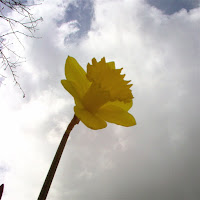
time of daffodils

E. E. Cummings wrote a poem I like in which he uses flowers to illustrate the dimensions of experience relating to time: time as change, remembrance, decision points, purpose in life, a sense of identity.

Right now I have patches of beautiful daffodils in front of my house. I planted their bulbs there several years ago, and today I get to enjoy them and share them with whoever may walk by.

"The goal of living is to grow." I reflect a lot on what I will do next. Where will I live after I leave this house behind? Do I want to take some of the flowers with me, or leave them? If I came back years later would I be sad to see them all pulled up and replaced with something else? Change can be really jarring, especially when it is something not in my control, not of my choosing. Do I really have control of anything, or is this notion just an illusion? People and relationships change. I change.

"The goal of living is to grow." And forgetting is as much a part of life as remembering. What will I forget about this place after I leave? Will I be able to forget some of the hurts that make me so timid to risk judgment and rejection?

When I leave here I probably would not have much reason to come back. But I would always be curious about what then happened to the things and people I leave behind.